Retail Real Estate Investment: A Complete Guide for Investors

September 7, 2026

Share


Many buyers overlook physical storefronts on the assumption that online shopping permanently reduced consumer foot traffic. Conditions on the ground point to a different picture, with limited new supply and selective investor demand shaping many suburban retail markets.
Retail properties can generate recurring lease income, but the durability of that income depends on location, tenant credit, lease structure, occupancy and acquisition basis. A successful retail real estate investment requires an acquisition framework that goes beyond simple cap rate math.
What Is Retail Real Estate Investment?
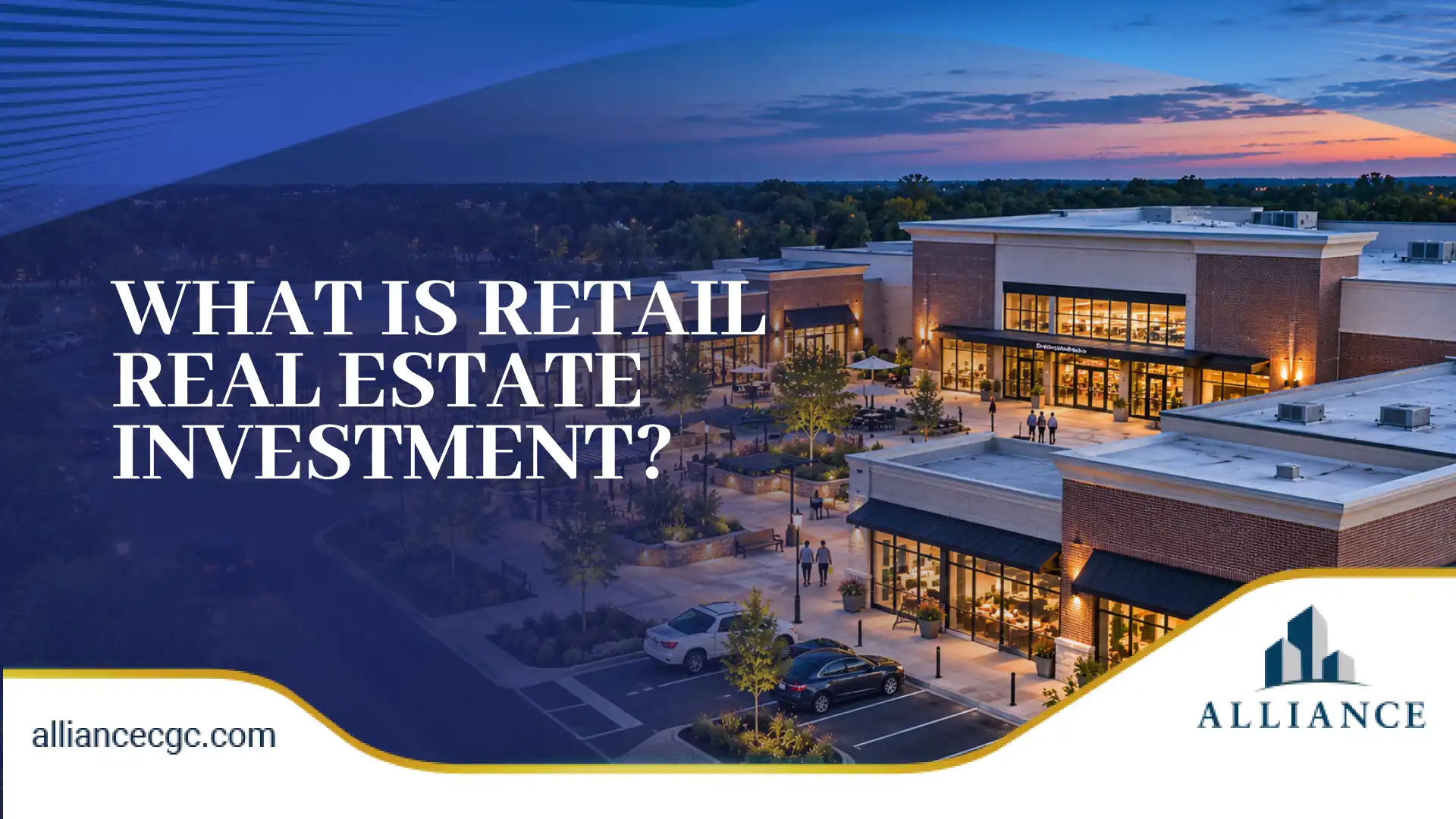
A retail real estate investment involves acquiring properties designed specifically for consumer-facing businesses to sell goods and services. This asset class differs from broader commercial real estate by focusing heavily on public visibility, consumer foot traffic and specific tenant zoning requirements. Evaluating these assets requires understanding the distinct formats currently operating in the market.
While different property configurations attract completely different tenant profiles and yield distinct risk parameters, buyers must align their capital strategy with the correct physical footprint.
Locking in your target property type immediately dictates what it takes to run the asset day-to-day. We lean on this exact framework internally to project accurate capital reserves and structure the specific lease agreements needed to protect our investors' cash flow.
Why Sophisticated Investors Buy Retail Commercial Property

Sophisticated investors ignore the outdated retail headlines and focus directly on the hard market data. These numbers reveal a massive opportunity to lock in durable cash flow while the rest of the market hesitates. Spotting this disconnect allows you to secure premium physical assets with serious long-term upside.
Retail Vacancy Sits Near a Decade Low
Finding quality retail space can be difficult for new businesses in many markets. CoStar forecasts United States retail vacancy to peak in the mid-4.4% range in 2026, edging slightly higher before stabilizing and gradually tightening in 2027. With new supply still limited, this environment can create advantages for current property owners:
- Landlords may hold stronger leverage during lease negotiations
- Tenant retention can improve when comparable space is harder to find
- Base rents may rise in markets with limited local inventory
Constrained supply can strengthen landlord positioning in healthy submarkets, but individual property performance still depends on tenant demand, rents, competition and lease economics.
New Retail Supply Remains Constrained
Current supply and demand fundamentals can favor owners of well-located retail property. Colliers forecasts new retail construction to fall roughly 37 percent in 2026, though some forecasts expect construction starts to begin rising from very low levels.
Limited new supply can support occupancy and rent fundamentals for well-positioned existing centers. That advantage has limits, since existing properties still compete with renovations, redevelopment, build-to-suits and new projects.
Grocery-Anchored Tenants Can Support Steady Income
Necessity-based retail can be comparatively resilient because demand for everyday goods tends to persist across economic cycles. Grocery-anchored centers, neighborhood strip centers and high-income suburban corridors are often well positioned for occupancy and rent growth.
Consumers still buy many daily essentials in person, which gives these formats a steady base of repeat visits.
These anchor tenants can contribute steady revenue to the underlying retail property investment. A more resilient income stream can support further retail real estate investment portfolio expansion, though leverage decisions still depend on each property's debt coverage and lease terms.
Institutional Capital Is Returning to Retail
Institutional investors have been returning to retail. U.S. grocery-anchored transaction volume reached roughly $11 billion in 2025, a 42 percent jump year over year. Different investor groups are pursuing different strategies within the sector:
- Some institutional funds target grocery-anchored suburban centers for long-duration, stable-income assets.
- Some global investors pursue Sunbelt neighborhood centers in high-growth demographic corridors.
- Some family offices focus on value-add repositioning of regional retail.
Institutional buyers currently hold their highest market share in over a decade. That activity is a useful market signal, though each investor still needs to weigh a deal against their own goals, capital and risk tolerance.
Retail Cap Rates Remain Higher Than Some Other CRE Sectors
Retail cap rates have stayed higher than several other commercial sectors. The average retail cap rate in Q2 2026 sat at 6.7 percent nationally, while multifamily and industrial properties traded at roughly 5.2 percent during the same period.
This spread means retail can offer a higher initial yield on purchase price, but it doesn't mean the risk is comparable across sectors. A higher cap rate can reflect higher perceived risk, capital needs or weaker growth expectations, so each property still needs to be underwritten on its own tenant, lease and market fundamentals.
Tenant Mix Now Drives Real Foot Traffic
The modern commercial retail real estate landscape evolved quickly beyond traditional apparel stores. Successful properties feature a tenant profile anchored by experiential, food and beverage, health and wellness and entertainment uses. These specific service-based businesses offer physical experiences that e-commerce cannot replicate.
Curating this exact mix drives consistent, internet-resistant foot traffic into the center. Sustaining that daily volume ensures long-term income durability and maximizes the ultimate exit value of the asset.
How Do Investors Evaluate and Improve Retail Real Estate Returns?
A profitable retail real estate investment depends on a disciplined framework from initial sourcing through final disposition. We walk our partners through a rigorous underwriting process on each deal, with the goal of protecting capital and supporting long-term returns.
The investment lifecycle calls for careful physical and financial validation at every stage. Skipping a phase can expose the portfolio to avoidable market risks.
Choose Your Investment Vehicle (REIT vs. Direct)
Evaluate the core differences in liquidity, control, capital requirements and tax treatment before deploying funds. The right option depends on whether you prefer a passive or active role, and it shapes the rest of your strategy. Many sophisticated buyers combine both vehicles to balance their market exposure.
Publicly traded real estate investment trusts (REITs) typically offer daily liquidity and lower minimums, but shareholders don't control the underlying properties. Direct ownership may provide access to depreciation and cost segregation strategies, along with more control over operations and value-add decisions.
Depreciation may affect the timing and character of taxable income, subject to the property, investor circumstances and applicable tax rules. Investors should consult their tax adviser.
Conduct a Retail Real Estate Market Analysis
Identify Sunbelt and Southeast demand drivers to position your target regions accurately. Analyzing grocery-anchored suburban corridors using the Dallas-Fort Worth market as a prime example reveals sustained demographic growth.
Track exactly where institutional capital is currently flowing to validate the specific location. As proper market selection directly fuels your long-term property syndication models.
Evaluate Deals Using Cap Rates and Income Analysis
Break down the basic cap rate formula to evaluate the pure relationship between purchase price and net operating income. Current benchmark ranges for top-market grocery-anchored centers sit tightly between 5.25 and 5.8 percent.
For example, a compressed cap rate signals lower perceived risk and higher asset quality to the broader market. Strict income analysis prevents buyers from overpaying in competitive environments.
Capitalization Rate Formula
NOI
÷ Current Market Value
= Capitalization Rate
Secure the Right Financing Structure
Review the full spectrum of financing options, including conventional, CMBS and bridge loans. Matching the loan structure to your asset's stabilization phase is a critical part of successful retail investing:
- Lenders typically evaluate occupancy, tenant credit, lease rollover, debt service coverage ratio (DSCR), reserves and the property's stabilization history; requirements vary by lender and loan program.
- CMBS suitability depends on loan size, stabilization, DSCR, tenant concentration, lease term and lender or securitization requirements. Smaller or transitional deals may be a better fit for small-balance commercial, local bank or bridge financing.
- SBA 504 financing is designed for owner-occupied properties, where your own business occupies the majority of the space. Pure rental acquisitions generally don't qualify, so investors buying retail centers for tenant income typically look to conventional, CMBS or bridge structures.
Evaluating how interest rates affect each of these options can help keep debt costs from eroding cash flow on your retail real estate investment.
Prepare for and Mitigate Operational Risks
Assess tenant concentration limits and vacancy exposure across the entire rent roll before closing any deal. Evaluating credit risk and lease structures, specifically concerning how they function in bankruptcy scenarios, prevents catastrophic income loss. Factoring in broader market and economic cycle shifts is equally vital before finalizing a retail property investment acquisition.
Implementing a strict risk mitigation framework utilizing tenant mix diversification and staggered lease expirations shields the portfolio. Essential anchors like grocers can safely occupy a much larger share of a center's leasable area, often 50 to 80 percent of total gross leasable area (GLA) since their credit profile and lease terms carry the property through downturns.
The real concentration risk sits with nonessential, discretionary tenants. Protecting your commercial retail real estate investment from full-vacancy exposure means limiting exposure to any single nonessential tenant and building a genuinely diversified inline mix around the anchor.
Execute Comprehensive Due Diligence
Order a Phase I Environmental Site Assessment to rule out legacy contamination and soil liabilities early in the vetting process. Following up by hiring licensed commercial inspectors to evaluate structural integrity, roof lifespan, Americans with Disabilities Act (ADA) compliance and heating, ventilation, and air conditioning (HVAC) systems prevents massive, unexpected capital expenditures.
Verifying the seller's documentation against actual banking records ensures the initial financial projections for your retail commercial real estate are grounded in reality.
Implement Active Asset Management and Exit Strategies
Execute targeted value-add improvements to justify rent increases and directly boost the asset's Net Operating Income. Pairing these upgrades with a proactive tenant retention program minimizes costly dark space and turnover expenses:
- Upgrading building façades and modernizing signage attracts higher-tier tenants to your retail real estate investment.
- Resurfacing parking lots and improving lighting directly increases consumer dwell time.
- Monitoring local transaction volume identifies the absolute peak disposition window.
Planning a 1031 exchange strategy allows investors to roll this forced equity cleanly into larger assets, finalizing a successful cycle of retail property investment.
Start Investing in Retail Real Estate Today

Hesitating on the sidelines means missing the current window of historically low supply and high tenant demand. Sophisticated buyers are actively locking in prime retail real estate investment properties right now, establishing their basis while the broader market waits for consensus coverage to catch up.
As someone who has built and managed a portfolio exceeding $500 million in commercial real estate assets with a 28 percent historical internal rate of return (IRR), I have seen firsthand that waiting for perfect market conditions only destroys potential yield. We aggressively target grocery-anchored and necessity-based retail assets that deliver immediate cash flow and hold immense pricing power over the long term.
If you are evaluating how this asset class fits into your wealth strategy, schedule a consultation with Alliance CGC to discuss current opportunities and build a market-positioned retail portfolio around your goals.
Retail Real Estate Investing FAQs
What makes a retail real estate investment profitable?
A retail real estate investment generates profit primarily through reliable tenant lease payments and long-term property appreciation. Profitability hinges on securing prime locations with high visibility and dense suburban demographics. Owners increase value by actively managing the tenant mix to drive foot traffic. Maximizing these returns requires diligent asset management to keep occupancy costs low and rental rates optimized against local market inflation.
How do cap rates impact retail property investment?
Capitalization rates provide a clear snapshot of an asset's baseline annual yield relative to its purchase price. A lower cap rate typically indicates a highly stable, premium property with strong credit tenants, while higher cap rates reflect elevated market or vacancy risks. Investors use this metric to compare potential acquisitions against other commercial assets quickly. Securing properties at a favorable cap rate establishes a wider margin of safety for your capital.
What are the main risks in retail commercial property?
The primary risks involve tenant concentration exposure and unexpected structural vacancies. If a large anchor tenant files for bankruptcy or refuses to renew a lease, the resulting dark space severely impacts net operating income. Economic downturns also threaten discretionary consumer spending, which hurts localized retailers. Owners mitigate these threats by diversifying their rent roll across necessity-based businesses and staggering lease expiration dates.
How does tenant mix affect retail commercial real estate?
The specific combination of businesses within a center dictates the daily volume and quality of consumer foot traffic. Modern successful centers prioritize experiential, health and necessity-based tenants over vulnerable soft-goods retailers. A highly synergistic mix encourages consumers to visit multiple stores during a single trip. Curating this environment creates an internet-resistant property that sustains long-term rental income.


